


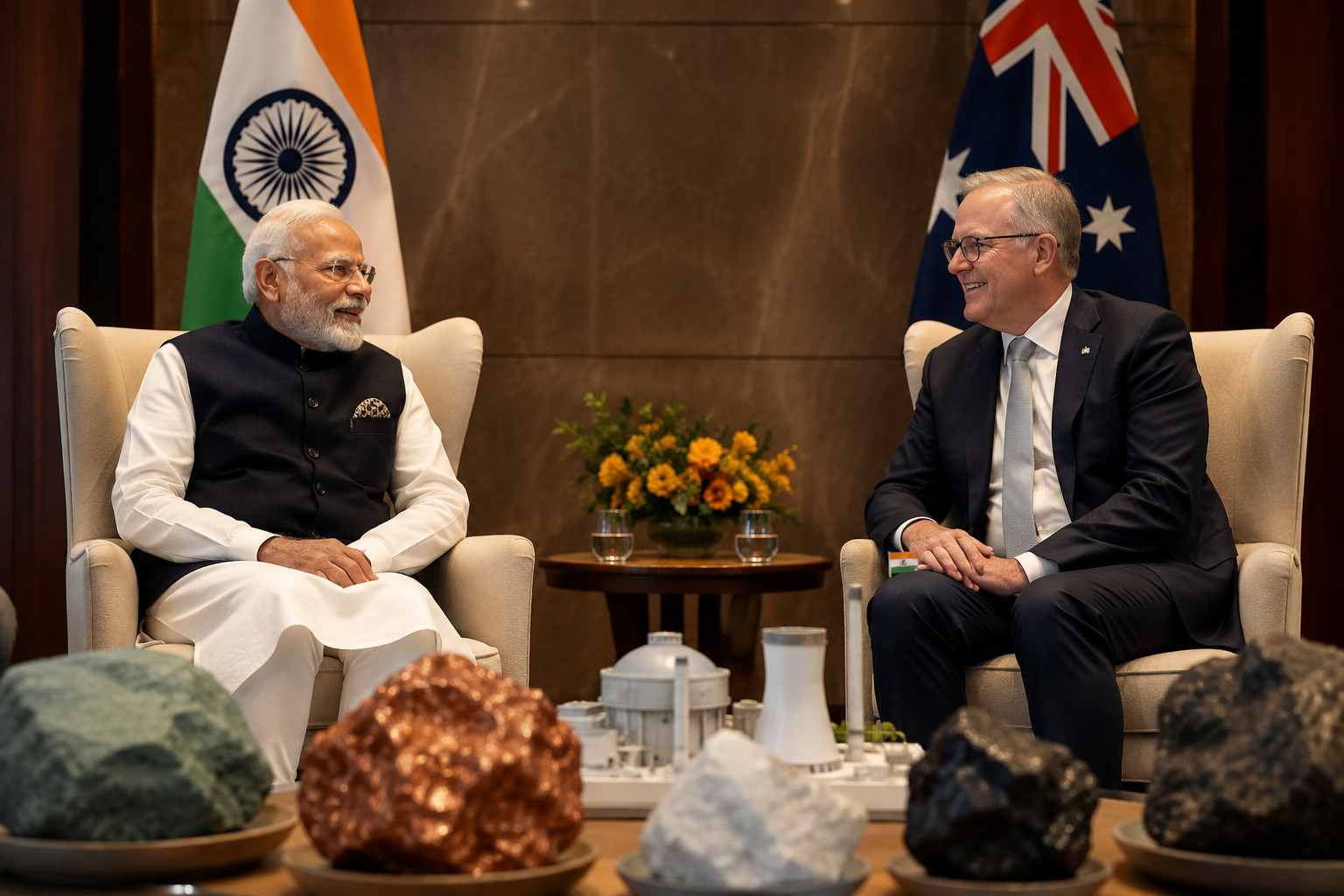
On 9 July 2026, India and Australia unveiled 18 landmark outcomes at the third Annual Leaders’ Summit in Melbourne, including operationalisation of the uranium supply pact, launch of a Critical Minerals Corridor, acceleration of the Comprehensive Economic Cooperation Agreement (CECA), a Joint Declaration on Defence and Security Cooperation, and the Australia-India Partnership on Cyber, Critical Technologies and Supply Chains (AI-PACTS). Bilateral trade has already grown 55% since the 2022 ECTA. For businesses, investors and economic development agencies on both sides, this reset creates immediate opportunities across clean energy, critical minerals, defence technology, education and financial services. T&A Consulting helps companies and governments navigate the India-Australia partnership and identify commercial opportunities.
Introduction: From ECTA to CECA — A Deepening Partnership
The India-Australia relationship has transformed over the past four years. The Economic Cooperation and Trade Agreement (ECTA), signed in 2022, eliminated tariffs on more than 85% of Australian goods exported to India and delivered a 55% increase in bilateral trade. The Melbourne Summit of July 2026 represents the next step: a move from initial trade liberalisation toward a comprehensive strategic and economic partnership spanning energy security, critical minerals, defence, technology, education and investment.
Prime Minister Modi described the outcomes as “unparalleled,” while Australian PM Albanese said the partnership was “not just for the present, but for the future.” The scale of the announced outcomes — 18 deliverables across multiple sectors — signals that both governments see the bilateral relationship as structurally significant for the Indo-Pacific order and the global clean energy transition.
Key Outcomes: What Was Agreed
- Uranium supply for civilian nuclear programme. The administrative arrangement under the 2015 Nuclear Cooperation Agreement was finalised, enabling commercial supply of Australian uranium to India under IAEA safeguards. This gives India a stable, ally-sourced nuclear fuel supply for its expanding civilian nuclear programme, supporting the country’s clean energy ambitions.
- Critical Minerals Corridor. Both countries launched a dedicated corridor to strengthen resilient supply chains for critical minerals essential for clean energy technologies, electric vehicles and advanced manufacturing. Co-investment frameworks across five identified projects were established, along with long-term offtake agreements from Australian lithium operations.
- CECA acceleration. Leaders instructed officials to conclude negotiations for the Comprehensive Economic Cooperation Agreement “at the earliest,” expanding liberalisation beyond the ECTA into services, investment and value-added goods. A bilateral investment treaty was also prioritised.
- AI-PACTS. The Australia-India Partnership on Cyber, Critical Technologies and Supply Chains was operationalised, covering cybersecurity, digital infrastructure resilience, supply chain diversification and emerging technology cooperation.
- Defence and maritime security. A Joint Declaration on Defence and Security Cooperation was adopted, an Annual Defence Ministers’ Dialogue instituted, a Maritime Security Collaboration Roadmap unveiled, and an India-Australia Defence Innovation Corridor announced to foster collaboration between defence industries and startups.
- Clean energy and renewables. A Rooftop Solar Training Academy will be established in Gujarat with Australian support. Progress under the bilateral Renewable Energy Partnership was highlighted, with cooperation expanding into green hydrogen, energy storage and grid modernisation.
- Education. Australian universities are expanding their India presence, with new branch campuses in Bengaluru and Gurugram. Educational cooperation was described as a central pillar of the partnership.
Critical Minerals: The Strategic Core
The critical minerals dimension of the India-Australia partnership deserves particular attention. Australia holds approximately 50% of the world’s lithium reserves, significant deposits of cobalt, rare earths and nickel, and established mining and processing infrastructure. India is building massive demand for these materials through its electric vehicle programme, battery manufacturing under PLI schemes, renewable energy expansion and semiconductor ambitions.
The strategic context is China’s dominance: a single country controls roughly 90% of the world’s rare earth refining capacity. Both India and Australia view diversified critical mineral supply chains as essential to economic security and clean energy independence. The Critical Minerals Corridor addresses this by creating bilateral investment frameworks, offtake certainty and processing partnerships that reduce dependence on Chinese refining.
For companies in the critical minerals value chain — miners, processors, battery manufacturers, EV companies and renewable energy equipment makers — the corridor creates defined investment pathways with government support on both sides. The CECA negotiations are expected to address tariff treatment for processed mineral products (not just raw ore), which would significantly reduce costs for Indian battery and clean tech manufacturers.
Sectoral Opportunities
- Mining and minerals processing. Australian mining companies can access India’s growing demand for lithium, cobalt, rare earths and nickel through the corridor’s co-investment frameworks and offtake agreements. Indian companies can invest in upstream Australian mining operations.
- Clean energy. Solar manufacturing, green hydrogen production equipment, battery assembly and energy storage systems are priority areas. The Gujarat solar training academy signals joint skills development for a growing workforce.
- Defence and aerospace. The Defence Innovation Corridor creates opportunities for startups and established companies in both countries to collaborate on dual-use technologies, maritime systems and cybersecurity solutions.
- Education. Australian universities are actively establishing India campuses. The CECA is expected to include services provisions that facilitate academic partnerships, student mobility and professional exchange.
- Financial services. The bilateral investment treaty and CECA services provisions will facilitate cross-border financial flows, investment management and insurance services between the two markets.
- AgriTech and food processing. India’s food services market is projected to reach $150 billion by FY31, while Australia is a major agricultural producer. The CECA is expected to expand market access for both countries’ agricultural products and food processing technologies.
Context: India-Australia Within the Trade Agreement Architecture
The India-Australia CECA, when concluded, will join an expanding network of trade agreements that positions India as a multi-market access hub. A company operating from India can already access preferential terms in the EU (India-EU FTA), the UK (India-UK CETA), EFTA nations (India-EFTA TEPA), ASEAN (India-ASEAN FTA), Japan (India-Japan CEPA), South Korea, the UAE and the United States (interim framework). Adding a comprehensive Australia agreement strengthens India’s position as a manufacturing and services base with preferential access to markets covering more than half of global GDP.
For Australian companies, the CECA creates a pathway to use India as a regional hub. An Australian company manufacturing in India can export to the EU, UK, ASEAN and other partner markets under India’s FTA network — a multi-market strategy that India-only or Australia-only positioning cannot deliver.
How T&A Consulting Supports India-Australia Business
T&A Consulting provides advisory for companies and agencies operating within the India-Australia partnership:
- Critical minerals strategy. We help Australian mining companies and Indian manufacturers identify partnership opportunities, navigate regulatory frameworks and structure co-investment arrangements under the Critical Minerals Corridor.
- Market entry strategy. We design India entry strategies for Australian companies and Australia entry strategies for Indian companies, incorporating ECTA/CECA provisions and sector-specific regulations.
- Education and campus advisory. We support Australian universities establishing campuses in India, covering regulatory processes, site selection, student recruitment and partnership development.
- Trade agreement advisory. We help companies leverage the full India-Australia trade framework (ECTA, CECA, bilateral investment treaty) alongside other Indian FTAs for multi-market access strategies.
- Investment attraction. We support economic development agencies on both sides in designing bilateral investment promotion campaigns.
The Melbourne Summit of July 2026 marks the moment when the India-Australia relationship moved from aspiration to architecture. Uranium, critical minerals, defence innovation, CECA acceleration and 18 deliverables in a single summit — this is a partnership being built with operational intent. The companies and agencies that engage now will be positioned for first-mover advantage in one of the Indo-Pacific’s most consequential bilateral corridors.
Contact us at: pnijhawan@taglobalgroup.com to explore India-Australia business opportunities.
Sources & references:
Business Standard,
The Tribune,
Discovery Alert,
DD India,
The Federal